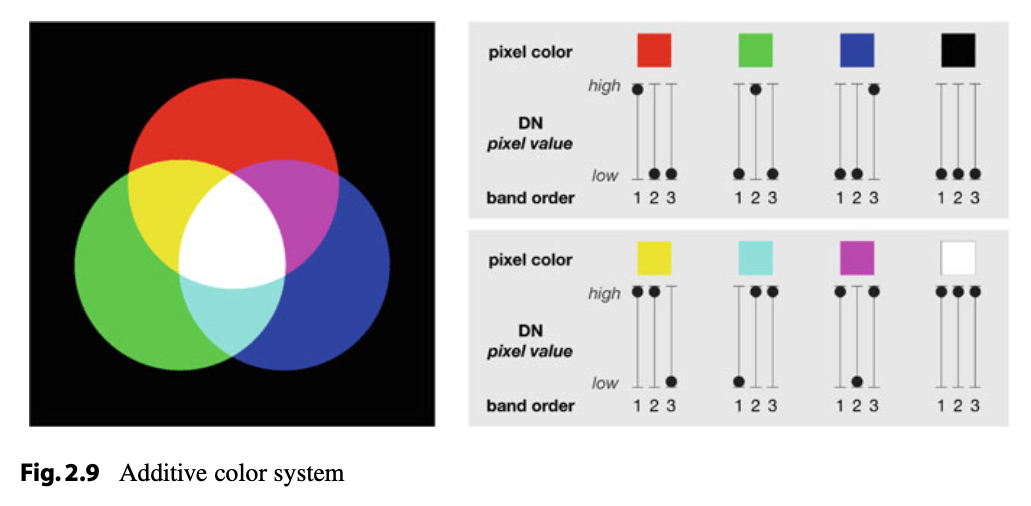
Introduction
The additive color system is based on the combination of visible light. Its three primary components are red, green, and blue (RGB). When these components are combined at different intensities, they produce a wide range of perceived colors. When all three are present at high intensity, the result is white light; when all three are absent, the result is black.
This principle differs from pigment-based color mixing. In paints or inks, combining colors generally reduces reflected light and produces darker tones. In additive systems, the combination of light increases brightness and expands the visible color range.
Primary Components
The three primary components of the additive color system are shown below.
| Pixel Color | Band 1 (Red) | Band 2 (Green) | Band 3 (Blue) |
|---|---|---|---|
| Red | High | Low | Low |
| Green | Low | High | Low |
| Blue | Low | Low | High |
| Black | Low | Low | Low |
Each primary color appears when one channel has a high value and the other two remain low. Black represents the absence of emitted light in all three channels.
Secondary Colors
Secondary colors are produced when two primary channels are assigned high values simultaneously.
| Pixel Color | Band 1 (Red) | Band 2 (Green) | Band 3 (Blue) |
|---|---|---|---|
| Yellow | High | High | Low |
| Cyan | Low | High | High |
| Magenta | High | Low | High |
| White | High | High | High |
The principal combinations are as follows:
- Red + Green = Yellow
- Green + Blue = Cyan
- Red + Blue = Magenta
- Red + Green + Blue = White
Digital Number Values
In digital imagery, the brightness of each color channel is represented by a digital number (DN). A high DN value indicates greater intensity in that channel, whereas a low DN value indicates weak or absent intensity.
For RGB image display, each pixel contains three values corresponding to red, green, and blue. The final displayed color depends on the relative magnitude of those three values.
Summary Table
| Resulting Color | Add These Lights |
|---|---|
| Yellow | Red + Green |
| Cyan | Green + Blue |
| Magenta | Red + Blue |
| White | Red + Green + Blue |
| Black | None |
Relevance in Remote Sensing
The additive color system is important in remote sensing because multispectral image bands are commonly assigned to the red, green, and blue display channels. This process allows grayscale band data to be visualized as color composites. Natural-color images use visible bands in their approximate visual positions, while false-color composites assign non-visible bands to RGB channels in order to emphasize vegetation, water bodies, soil, or built-up land.
Conclusion
In the additive color system, color is produced through the controlled combination of red, green, and blue light. The model is fundamental to digital displays and central to the interpretation of remotely sensed imagery, where band combinations are used to generate informative visual representations of the Earth's surface.